LINFO2172 Cheatsheet
Cheatsheet for the LINFO2172 course at UCLouvain, covering the main concepts of the course. This isn't a complete summary
and you should of course read the slides and refer to the course material for a complete understanding.
Source-code is available at GitHub. Feel free to contribute !
ER Diagrams
Mindmap
Conceptual design
Visualization of information we conceptually plan to store, how we link tables isn't done here, just the entities and their attributes.
Physical design
Every attributes in relational database is listed, how we link tables is done here.
Relationships multiplicity
Note : mermaid uses ER Crow's Foot notation, it's recommended to know all representations for the exam.
1:1 multiplicity, not mandatory
M:N multiplicity, not mandatory
1:N multiplicity, not mandatory
1:N multiplicity, mandatory (left hand side)
1:N multiplicity, mandatory (both sides)
Ternary relationship
In ER Chen's / ORM : additional diamond / boxes are used to represent ternary relationships, but in Crow's Foot and UML, add boxes and lines to represent the relationship.
Constraining relationships
-
-
For a degree relationship, any constrait must cover entities, otherwise we can split relationships into smaller ones.
Misc
- Entities can be related to themselves
- Don't forget to add primary keys (PK) and foreign keys (FK).
- Composite keys : keys made of multiple attributes
- Multi-valued attributes : attributes that represent a set of values.
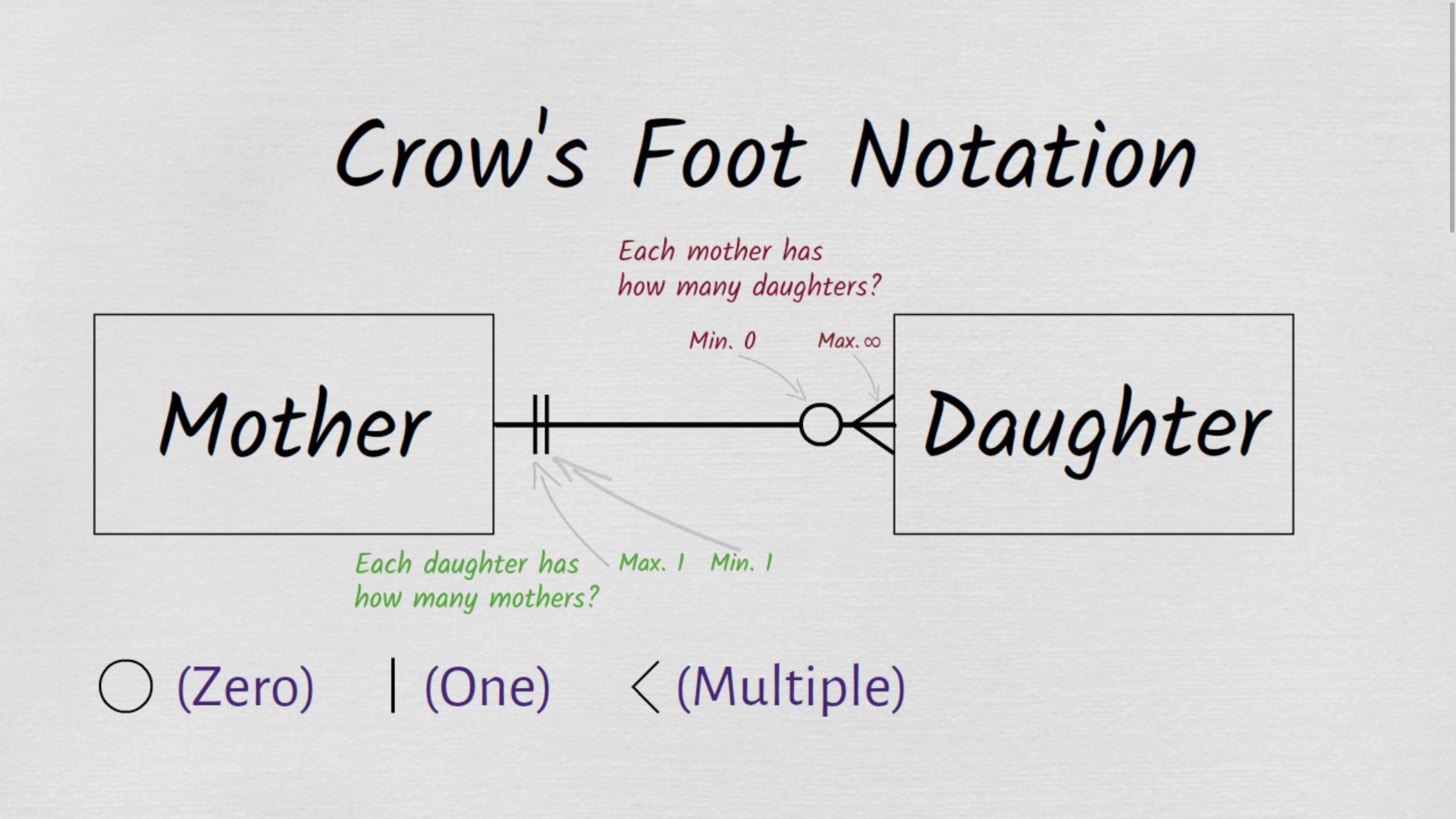
- When having a many to many relationship you cannot directly represent it in a database so you create a middle table
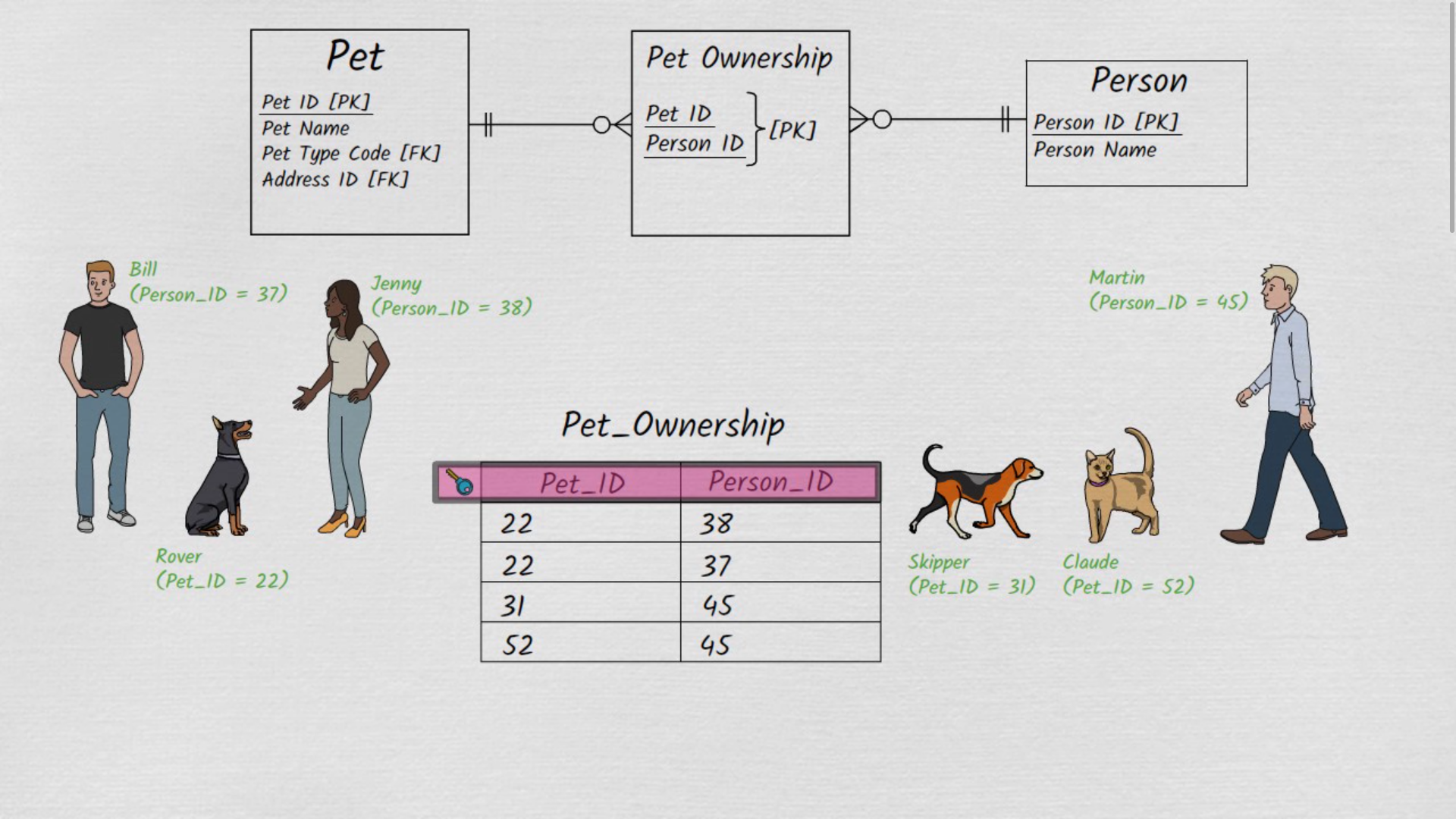
Weak entities
Entities whose existence depends on another entity
- Cascade delete : if the parent entity is deleted, the weak entity is also deleted.
- Weak entities are represented with a double rectangle in ER Chen, aggregation in UML, no specific representation in Crow's Foot / ORM.
Conceptual design Physical design
- Convert entities and their single-valued attributes
- Convert weaker entities and their single-valued attributes. Then add foreign key attributes for the owner entity.
- Convert M:N relationships, with additional relation with foreign keys for connected entities.
- Convert 1:1 relationships:
- With same method as M:N relationships or
- Add key of one related entity as foreign key in the other entity.
- Merge both entities into one, if applicable
- Convert 1:N relationships with same options than 1:1 relationships
- Convert multi-valued attributes
Enhanced ER Diagrams
Extend ER diagrams with class and subclass relationships
Inheritance
- Subclass : entity that inherits from another entity, can have additional attributes.
- Superclass : entity that is inherited from, with common attributes.
- Multiple inheritance is allowed
Specialization and generalization
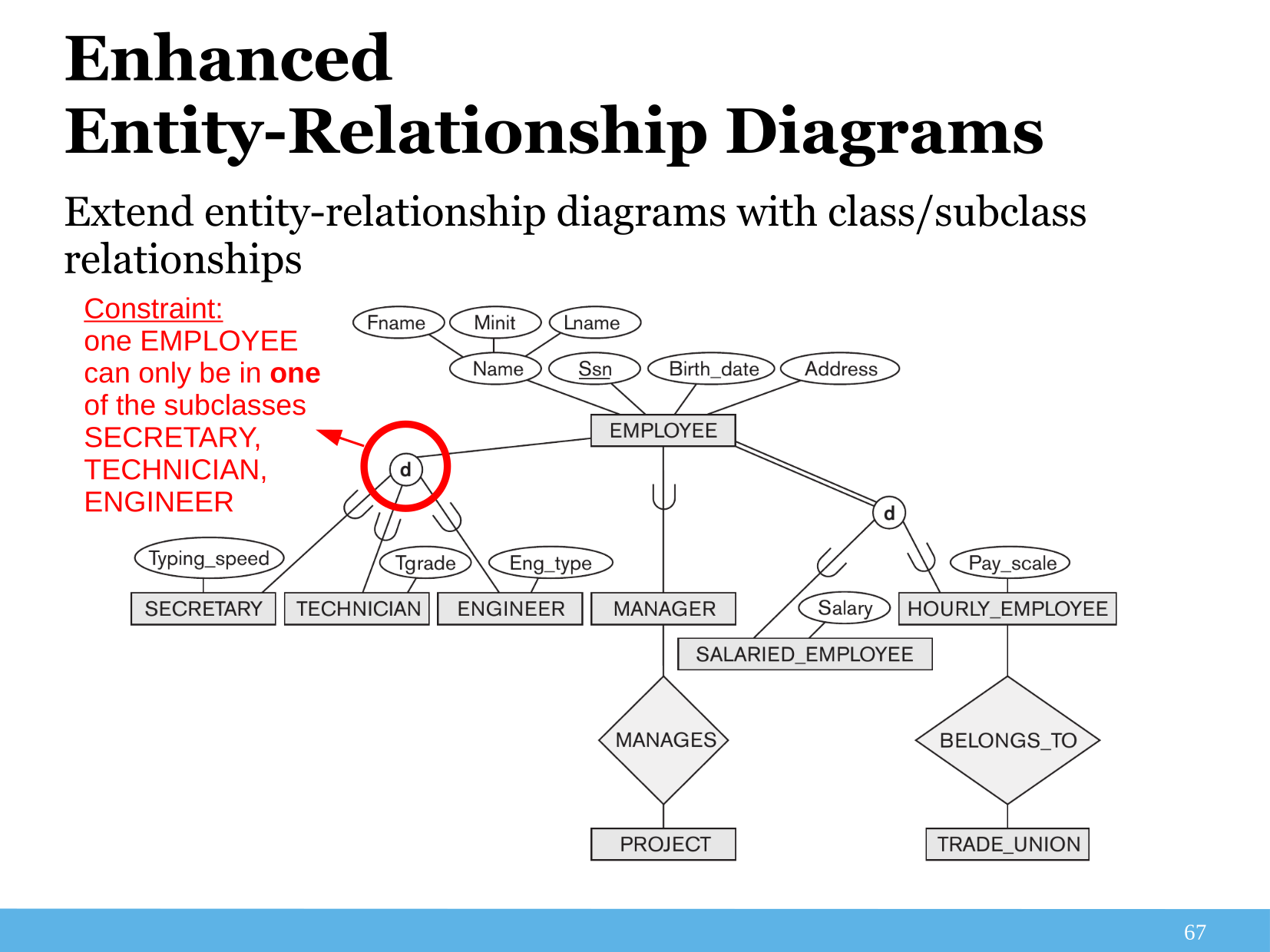
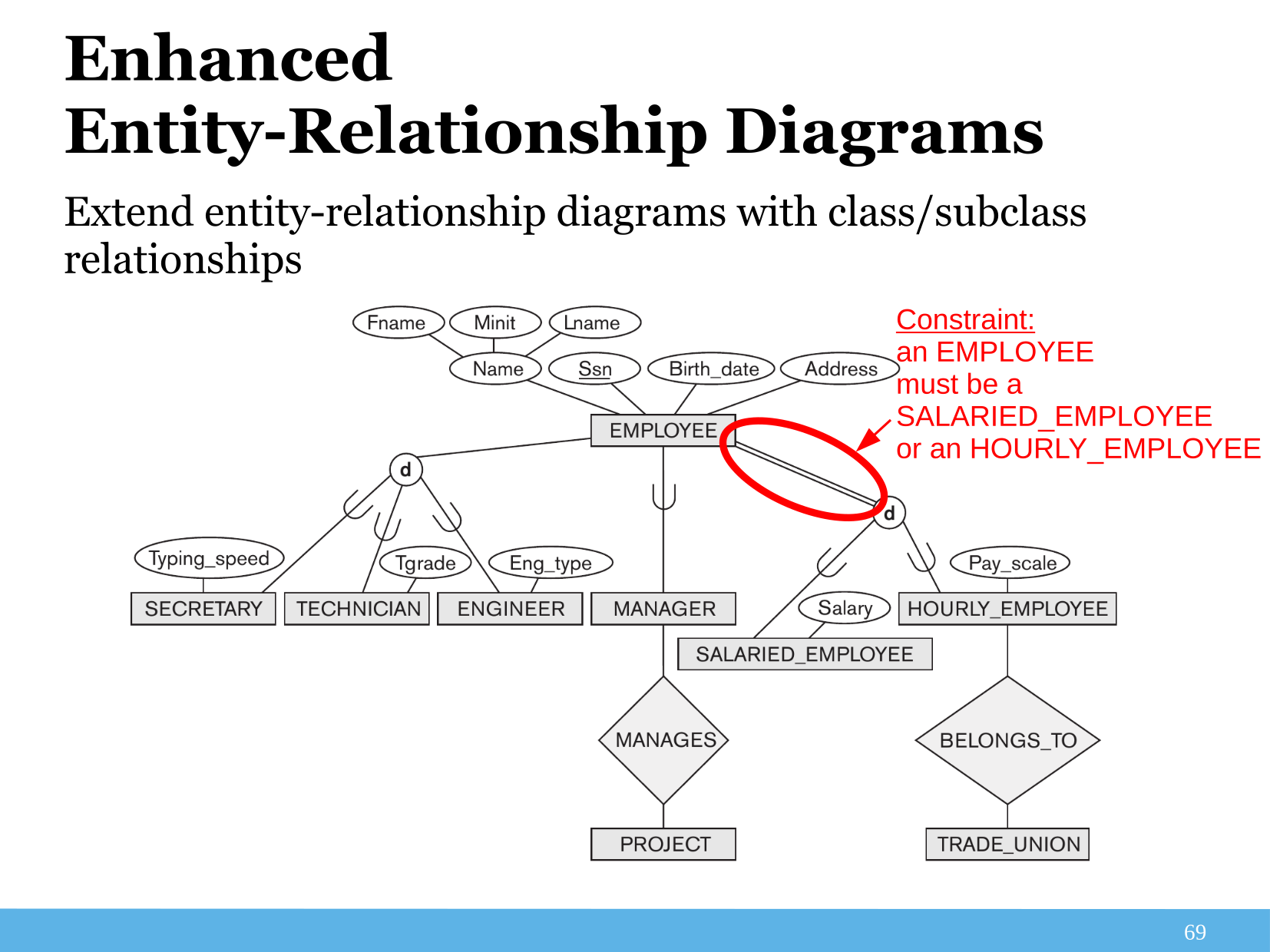
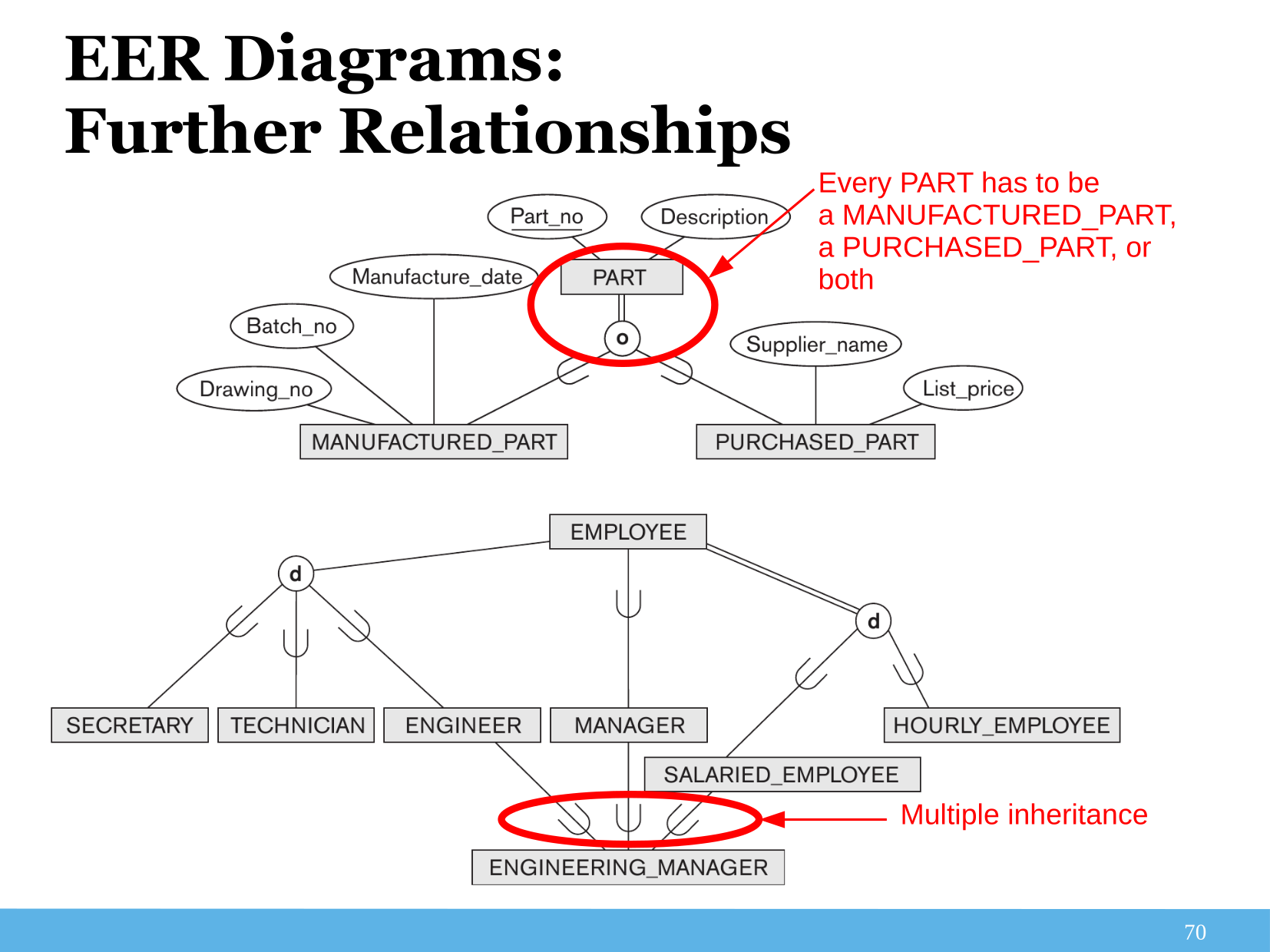
Converting EER to relational schemes
Choose one of the following methods:
- Create a relation for every entity, using FK to refer subclasses to superclass
- put every entities in one relation, adding attributes to identify the subclass to which a tuple belongs to
- Create a relation for every entity in a total inheritance, but not for superclass
Relational Model and Integrity Constraints
Mindmap
Domain constrains
Set of values that an attribute can take for every attributes
- SQL has built-in types (int, varchar, date, etc.)
- Range restrictions can be added with CHECK constraints
Key constraints
Identify a row uniquely in a table
Superkey
- A key is a minimal superkey
- If a relation has multiple keys, all keys are called candidate keys
- Primary key (PK) is a chosen candidate key
FK constraint
When a relation A refers to the PK of another relation B, A never contains values that are not present in B
Constraint violation
Default behavior is to reject the operation
Transactions and ACID properties
A transaction is a sequence of operations that are executed in a ACID way
ACID
- Atomicity : a transaction is an atomic unit, either all operations are executed or none.
- Consistency : after transaction, all integrity constraints are satisfied.
- Isolation : transactions are isolated from each other, concurrent transactions do not interfere with each other.
- Durability : once a transaction is committed, its effects are permanent, even in case of (power) failure.